The Last Coke Rolex Ever Made — A 2007 Final-Year Production Piece
The red-and-black “Coke” bezel has one of the most historically resonant stories in all of GMT-Master collecting. It first appeared in 1983 on the 16760 “Fat Lady” — the original GMT-Master II — where it was the only bezel configuration available, making the Coke the foundational identity of the entire GMT-Master II lineage from its very first day in production. When the 16710 replaced the 16760 in 1989, Rolex offered three different bezels — the red-and-black Coke, the red-and-blue Pepsi, and the solid black — and the 16710 ran for 18 years until 2007, after which it was succeeded by the ceramic-bezel 116710 generation. The critical detail for collectors: the 16710 was the last GMT-Master II ever produced with a Coke bezel. When Rolex replaced it with the 116710 in 2007, the Coke colorway disappeared from the GMT-Master II catalog entirely — and it has never returned on a production steel reference. This 2007 example is from the final production year of the reference — the last Coke GMT-Master IIs Rolex ever built — making it simultaneously the most current and the most historically terminal example of the most historically significant bezel color in the GMT-Master’s story.
The Timing of This Listing Could Not Be More Significant
The market context for this listing is extraordinary. At Watches & Wonders Geneva 2026, Rolex officially discontinued the GMT-Master II “Pepsi” 126710BLRO — the first time since 1954 that a Pepsi-bezeled GMT-Master has been absent from Rolex’s active production catalog. Because Rolex opted not to replace it, the Pepsi’s exit leaves a massive vacuum. Secondary market prices for these references, which already commanded steep premiums, are expected to climb aggressively as the finite supply is permanently capped. With the modern ceramic Pepsi now gone, collector attention across the GMT-Master II universe has sharpened considerably — and the Coke, already discontinued since 2007, benefits directly from that sharpened focus. The red-and-black colorway that defines the “Coke” has been absent from the Rolex catalog since 2007, making these discontinued GMT-Master II models increasingly collectible. A 2007 full-set Coke in very good condition, freshly serviced in August 2025, is precisely the kind of documented, well-maintained piece that serious GMT-Master collectors compete for in this environment.
2007 Production — The Final-Year Caliber 3186 Upgrade
The 2007 production year carries a specific and important technical significance within the 16710 family. The Rolex 16710 received a Caliber 3186 movement towards the very end of its run, replacing the outgoing Caliber 3185. The 3186 has a Parachrom hairspring, providing greater magnetic resistance. A 2007 example sits at the end of the production run where the Caliber 3186 was fitted — making it the most mechanically advanced version of the 16710 reference, carrying the same blue Parachrom hairspring technology that Rolex would subsequently carry forward into the 116710 generation and beyond. Other evolutionary changes over the 16710’s production run included bracelet end links transitioning from hollow to solid around 2000, and the laser-etched Rolex crown appearing on the crystal from 2003. A 2007 example carries all of these upgrades simultaneously — solid end links, laser-etched crown, and Caliber 3186 — making it the most complete and most refined expression of the 16710 reference.
904L Oystersteel Case — Classic Pre-Supercase GMT Proportions
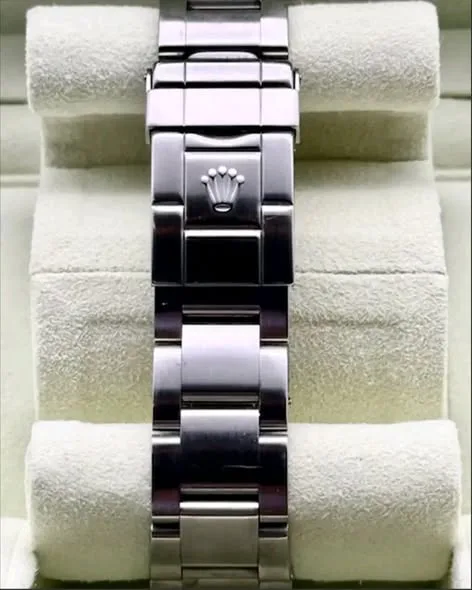
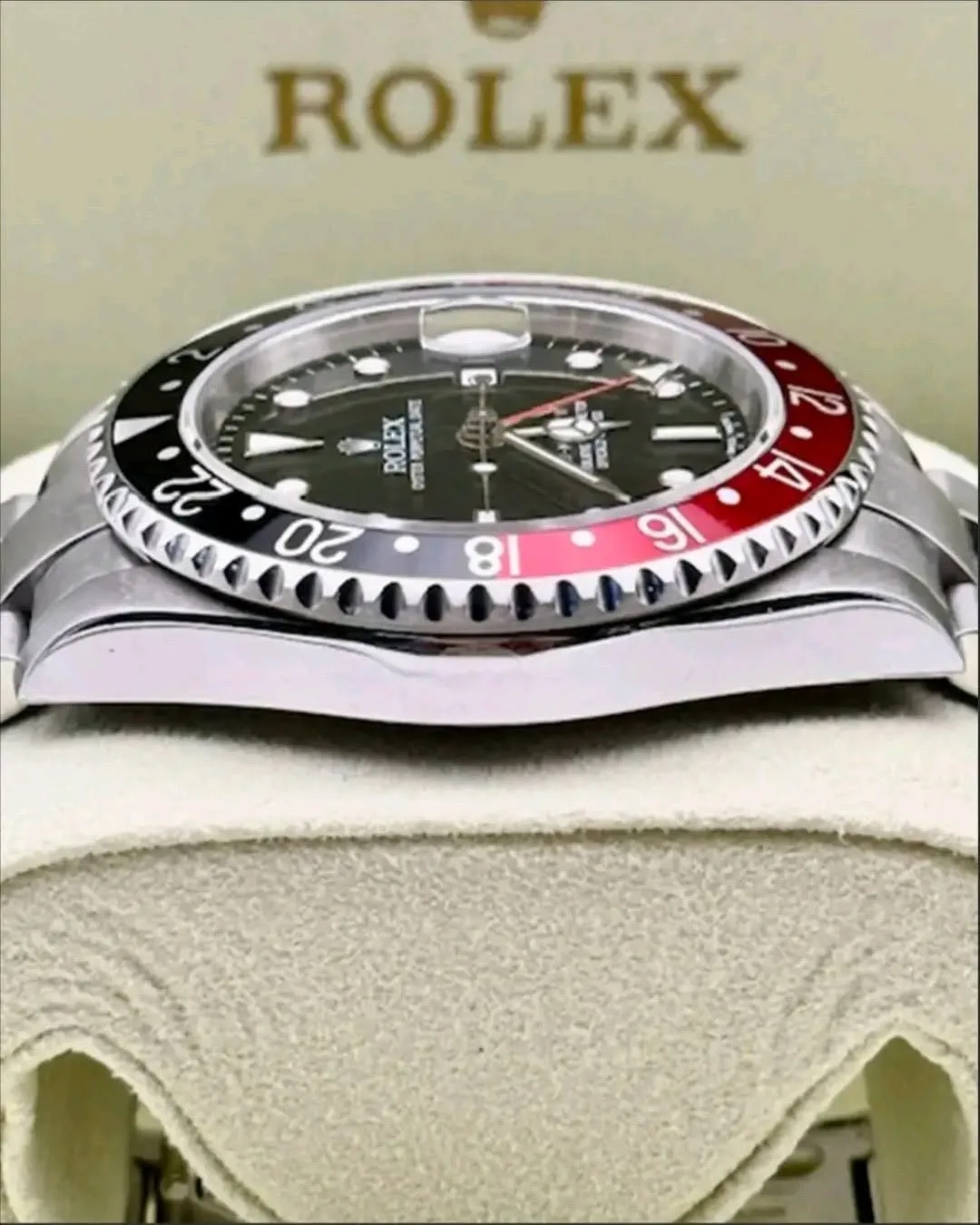
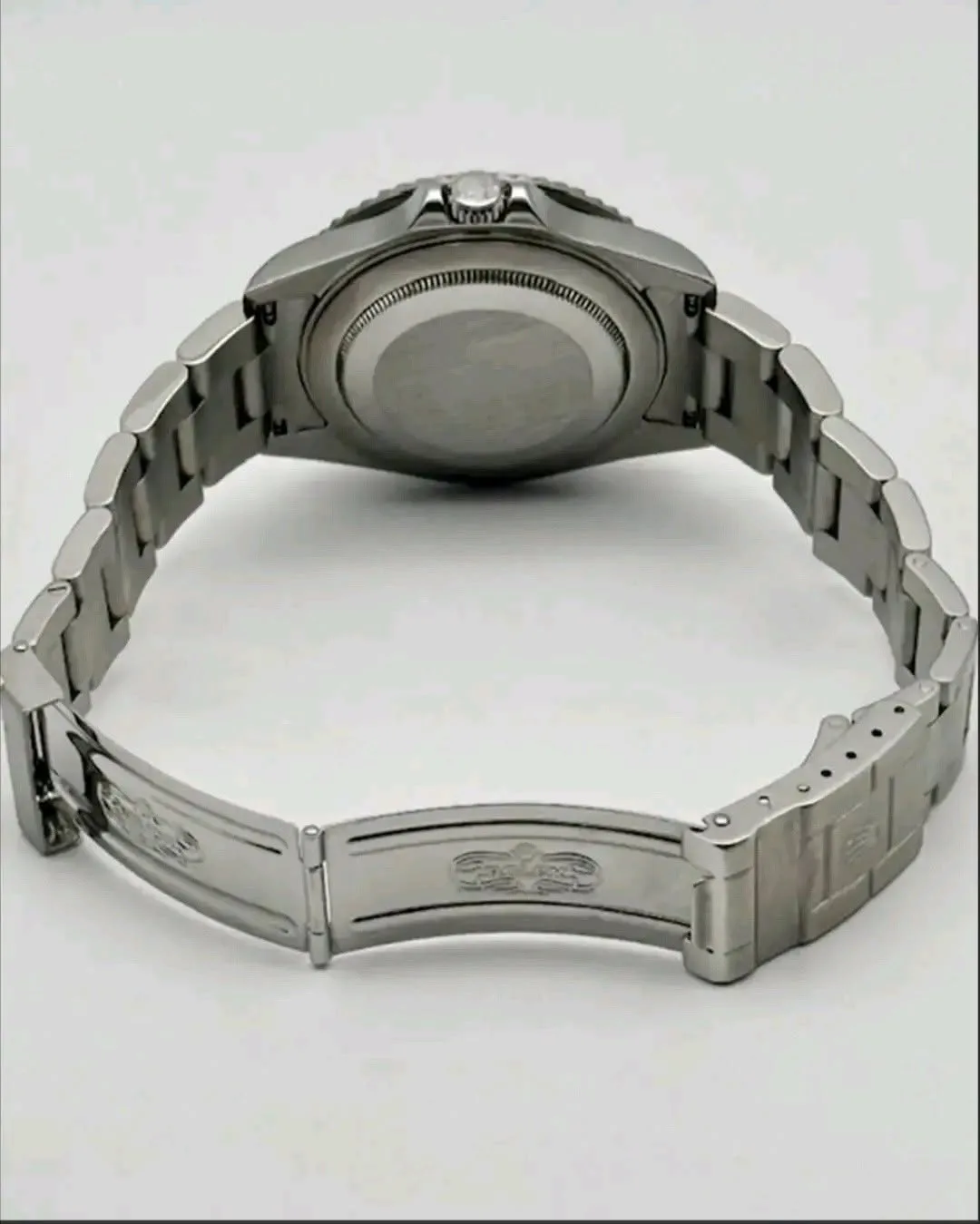
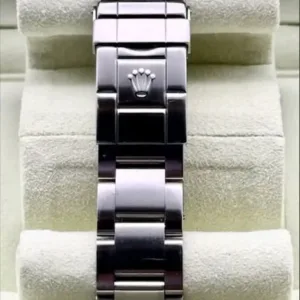
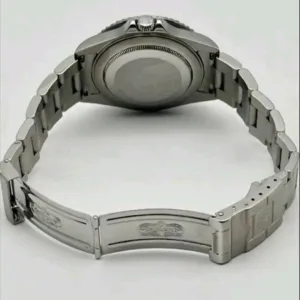
The 40mm Oyster case is crafted from Rolex’s proprietary 904L stainless steel with the classic pre-Supercase GMT-Master II profile: Twinlock screw-down crown, crown guards providing protection on either side, and water resistance rated to 100 meters. Key differences between this reference and its 116710 successor include the case design — broader “Super Case” lugs on the 116710 versus the classic, more refined lug profile of the 16710 — and the crown system, with a Triplock on the 116710 versus the Twinlock on the 16710. The pre-Supercase proportions of the 16710 give it a wrist presence that a meaningful contingent of collectors and daily wearers actively prefer — slimmer, lighter, more elegantly proportioned, and more comfortable under a shirt cuff than the broader Maxi-case generation that replaced it. A flat sapphire crystal with laser-etched Rolex crown protects the dial, and the solid-endlink Oyster bracelet closes with the Oysterlock safety clasp.
The Red and Black “Coke” Aluminum Bezel — The Original, The Last
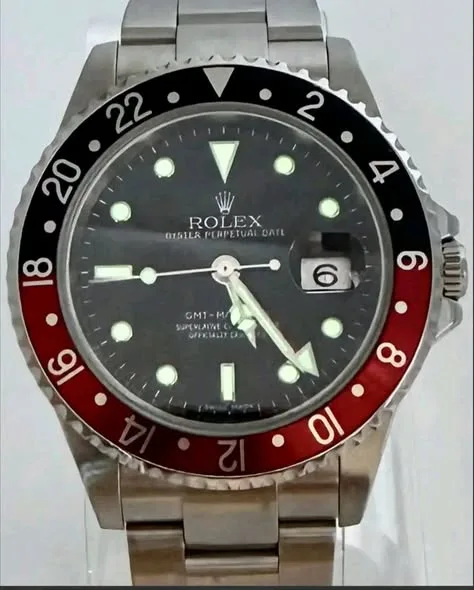
The bidirectional rotating 24-hour bezel is fitted with the iconic red-and-black aluminum insert — the “Coke” configuration that collectors associate with the very beginning of the GMT-Master II story and the very end of the aluminum Coke era simultaneously. The bezel rotates with 120 clicks — twice the number of click positions as the modern Cerachrom bezels — giving the 16710’s bezel a finer, more precise graduation feel that many experienced GMT wearers prefer for exact time zone reading. The red half of the 24-hour scale covers the daylight hours, the black half covers nighttime — exactly the same functional logic that Pan Am’s pilots relied on in 1954 — and the bezel rotates bidirectionally to allow setting a home time zone in either direction from local time. Aluminum bezels develop individual patina over years of exposure — subtle color shifts, surface character, and warmth that are entirely specific to each individual watch — giving the 16710 Coke’s bezel a living, evolving quality that the modern Cerachrom ceramic can never replicate.
The Black SuperLumiNova Dial — Clean, Functional, and Authentic
As a 2007 production piece, this example carries SuperLumiNova luminescent material — the brightest and most modern lume fitted to the 16710 across its production run, succeeding the earlier tritium and LumiNova variants of earlier production years. The lume transition across the 16710’s production run ran from tritium until 1997, then LumiNova through 1998-2000, and then SuperLumiNova from 2000 onward. Applied dot and baton hour markers in white gold with SuperLumiNova fills provide clear, high-contrast legibility on the black dial surface, and the red arrow-tipped GMT hand circles the dial once every 24 hours — finished in red to mirror the red half of the Coke bezel above and immediately distinguishable from the regular hour hand at any light level. The date is displayed at 3 o’clock beneath a standard flat magnifier, and the dial is signed with the full four-line text confirming Superlative Chronometer certification of the Caliber 3186 inside.
The GMT-Master II Complication — Three Time Zones at a Glance
The GMT-Master II’s defining advance over the original GMT-Master is the independently adjustable hour hand — a mechanism that allows local time to be set by advancing or retarding the hour hand in one-hour increments while the minute and seconds hands continue running undisturbed, and while the red GMT hand continues its 24-hour reference time display. The result is a watch capable of tracking three simultaneous time zones — local time on the hour hand, reference time on the GMT hand and bezel, and the date at 3 o’clock — without stopping the movement or requiring any crown-pulling sequence beyond the standard time-setting position.
Powered by Caliber 3186 — The Most Advanced Movement Ever Fitted to the 16710
The GMT-Master II 16710 was powered by the Rolex Caliber 3185 and later the updated Caliber 3186, both renowned for their precision and reliability in offering dual time zone functionality. The Caliber 3186 fitted to this late-production 2007 example operates at 28,800 vibrations per hour with 31 jewels and a 48-hour power reserve, featuring quickset date, hacking seconds, and independently adjustable hour hand via the crown’s first position. The blue Parachrom hairspring — the same paramagnetic zirconium-niobium alloy hairspring that Rolex carried forward into all subsequent GMT movements — provides meaningful resistance to magnetic fields and temperature fluctuations that the earlier Nivarox hairspring of the Caliber 3185 does not match. The movement is regarded by watchmakers worldwide as thoroughly reliable, straightforward to service, and extremely well-suited to decades of continued daily wear — a testament to Rolex’s movement engineering philosophy of prioritizing longevity over novelty.
Serviced August 2025 — Mechanically Fresh and Ready to Wear
This example was professionally serviced in August 2025 — less than a year before this listing — providing the movement with a documented clean point in its mechanical history and ensuring it is running within Rolex’s accuracy specifications. A freshly serviced vintage GMT-Master II is meaningfully more purchase-ready than an unserviced equivalent: the movement has been cleaned, lubricated, regulated, and inspected, the case and bracelet resealed, and the water resistance tested. For a 2007 watch, a documented 2025 service is exactly the maintenance record a serious buyer wants to see, providing both peace of mind and a known mechanical baseline from which the watch can be worn daily without concern.
Condition & What’s Included
This 2007 example is in very good condition and comes as a full set with original Rolex box and papers. Authenticity is fully guaranteed with reliable references on every watch sold through The Crown Collection Watch.
Shipping & Payment
This watch is priced at $10,399 with free insured shipping within the USA and Canada, and worldwide shipping available. Leave a message for further details or additional photos.
Why This Reference Stands Out
The red and black bezel that defines the Coke has been absent from the Rolex catalog since 2007, making these discontinued GMT-Master II models increasingly collectible. Pre-owned Coke 16710 examples typically range from $10,000 to $17,000+. At $10,399 for a 2007 final-year production example — the most mechanically advanced 16710 with Caliber 3186, solid endlinks, and laser-etched crown — freshly serviced in August 2025 and offered as a full set with box and papers, this listing sits at the entry end of the market range for a reference that is simultaneously the rarest of the three 16710 bezel configurations by remaining supply and the most historically significant by lineage. In a 2026 secondary market where the modern ceramic Pepsi has just been discontinued and collector attention across the entire GMT-Master color spectrum has intensified sharply, a full-set freshly serviced Coke at this price represents outstanding value and exceptional timing.












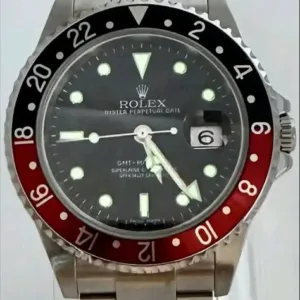 Rolex GMT-Master II “Cok...


Reviews
There are no reviews yet.