Built for the Edges of the Earth — The Polar Explorer II
The Rolex Explorer II has one of the most specific and purposeful origin stories in all of watchmaking. Introduced in 1971 as a direct evolution of the original Explorer — itself born from Rolex’s partnership with Edmund Hillary and Tenzing Norgay’s 1953 Everest expedition — the Explorer II was developed for a very particular problem faced by a very particular kind of adventurer: the cave explorer, or spelunker. Spending long hours in underground labyrinths without any natural light causes the human circadian rhythm to drift, and without any visual cue from the sun, cave explorers lose their sense of whether it is day or night. The Explorer II solved this with an additional 24-hour hand — circling the fixed 24-hour bezel once every 24 hours — that shows whether any given hour is ante meridiem or post meridiem at a single glance. The white “Polar” dial of this reference brings that solution into its sharpest, most legible form — a bright white surface that provides maximum contrast against every marker, hand, and indicator on the dial, making it the most readable configuration in the Explorer II lineup and the one that best serves the watch’s original purpose of functioning in environments where human vision is compromised.
The Polar Dial — A Legacy Configuration Reborn in the 226570
The “Polar” nickname honors a lineage stretching back to the reference 16570 of the 1980s and 1990s, where the white dial was associated with the watch’s use in extreme polar environments — Arctic and Antarctic expeditions where visibility is compromised by snow blindness, low sun angles, and the featureless white of ice fields. Reference 226570, introduced in 2021 as the current-generation Explorer II, delivers the Polar configuration with all the technical refinements of the modern Rolex platform: redesigned hands and hour markers with enhanced Chromalight luminescent material, ensuring exceptional legibility in dark conditions for up to eight hours, a slimmer and more wearable case than the previous 216570, and the Caliber 3285 movement that is shared with the GMT-Master II family. The Explorer II 226570 doesn’t get the attention of a Submariner or GMT-Master II, and that is precisely part of what makes it interesting — it is a 42mm steel sports watch with a true second time zone, a high-contrast dial, and the modern Caliber 3285 running underneath, offered at a price point that represents genuine value relative to its more famous sport-watch siblings.
904L Oystersteel Case — 42mm of Pure Tool Watch Character
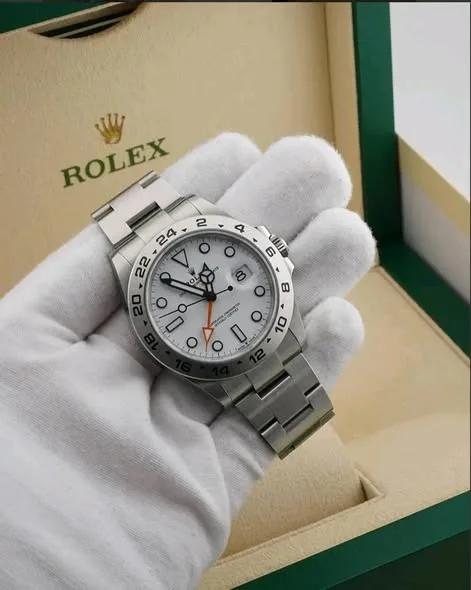
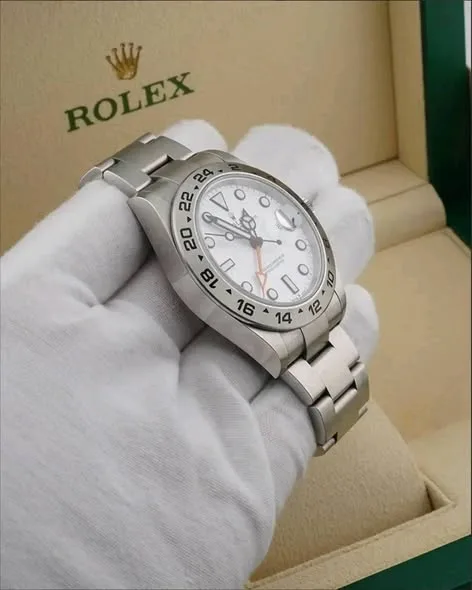
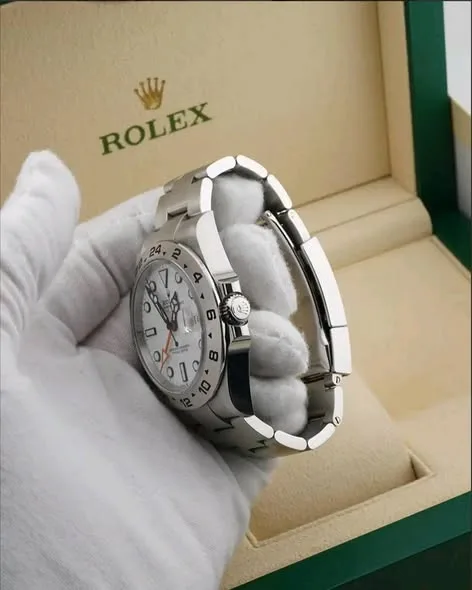
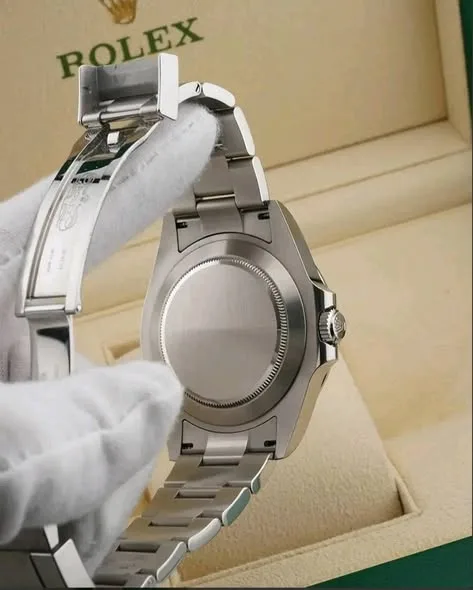
The case is made of stainless steel with satin-finished lugs and mirror-finished sides. The 24-hour bezel mounted atop is satin-finished stainless steel. Both crown and solid caseback are screw-down. The 42mm Oyster case is crafted from Rolex’s proprietary 904L stainless steel — a high-corrosion-resistant alloy delivering a deeper, more reflective polish than the 316L steel used by most competing manufacturers, maintaining its surface integrity across decades of active wear in the world’s most demanding environments. At 12.5mm in thickness, the case is substantial without being unwieldy — sitting with authority on the wrist while remaining slim enough to clear a shirt cuff in professional contexts. The screw-down Triplock triple-waterproofness crown provides 100 meters of water resistance, and the solid screw-down caseback seals the Caliber 3285 inside. A scratch-resistant sapphire crystal with Cyclops magnifying lens sits over the date window at 3 o’clock, and the laser-etched Rolex crown at 6 o’clock provides an additional authentication detail visible only under magnification.
The Fixed 24-Hour Bezel — The Feature That Defines the Explorer II
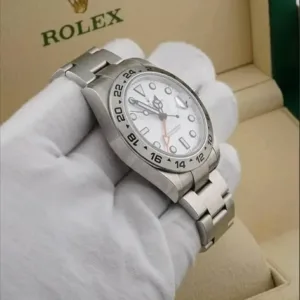
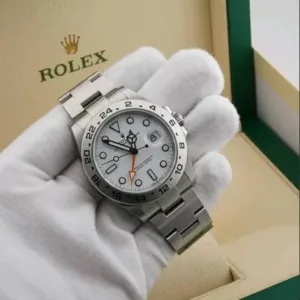
The most immediately distinguishing feature of the Explorer II — the detail that separates it from every other Rolex sport watch — is its fixed, non-rotating 24-hour bezel. The 24-hour bezel on the Explorer II is fixed, not rotating like the GMT-Master II. That’s the functional difference between the two models. With the Explorer II you read a single second time zone off the 24-hour hand; with the GMT-Master you can track a third time zone by rotating the bezel. Both approaches work, they just suit different users. The satin-finished steel bezel carries the 24-hour scale engraved into its surface, with numerals filled for legibility, providing the reference against which the orange GMT hand displays a home or reference time zone continuously and automatically. The fixed bezel is the more direct, more immediately legible solution for the traveler who primarily needs to know whether any given hour is day or night — no rotation required, no setting needed beyond the initial calibration of the GMT hand.
The White Polar Dial with Orange GMT Hand — The Explorer II’s Visual Signature
Functions are displayed on a white polar dial that is accompanied by blue luminescent-filled hands and luminous hour markers. Featured on the dial: a large central sweeping seconds hand, magnified date window at 3 o’clock, and large central orange GMT hand. The white lacquered surface provides the maximum possible contrast for the black-outlined baton and dot hour markers, the black Mercedes-style hands, and the signature orange GMT hand that has defined the Explorer II’s visual identity since the very first generation in 1971. The polar configuration pairs the white dial with black outline hands and markers, and the orange GMT hand is the visual signature that ties this reference to the Explorer II lineage. The orange GMT hand is one of the most immediately recognizable details of any Rolex sport watch — a single sweep of color that circles the dial once every 24 hours, tracking the passage of a full day against the fixed bezel above it, and providing an at-a-glance day/night indicator for any reference time zone on earth. The Chromalight luminescent fills in the hour markers and hands emit a long-lasting blue glow in darkness for up to eight hours — providing the low-light legibility that cave explorers and polar adventurers have relied on since the original Explorer II’s debut over fifty years ago.
The Independent GMT Hour Hand — True Dual-Timezone Functionality
The local hour hand jumps in one-hour increments without stopping the seconds, which is how you use a GMT watch when you’re changing time zones. The Caliber 3285 allows the local hour hand to be advanced or retarded independently via the crown’s rapid-setting position — a true GMT complication, not merely a 24-hour hand that reads only against a fixed scale. The result is a watch capable of displaying two simultaneous time zones: local time on the standard hour and minute hands, and home or reference time on the orange 24-hour GMT hand and fixed bezel. The date at 3 o’clock beneath the Cyclops lens completes the practical information package, advancing instantaneously at midnight regardless of which time zone is being tracked on the standard hour hand.
The Oyster Bracelet with Easylink Extension
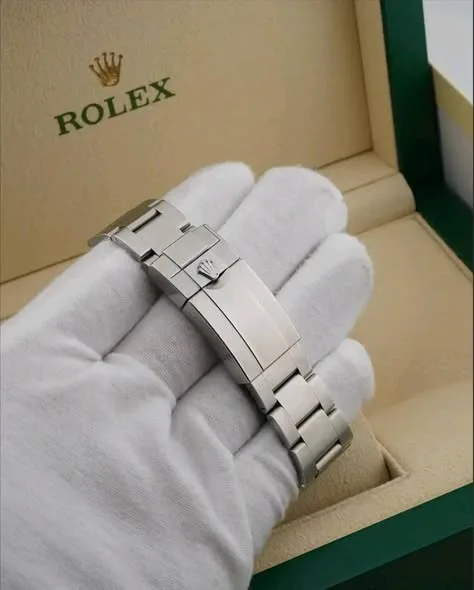
The Oyster bracelet with Easylink extension enhances comfort and versatility. The Oyster bracelet is stainless steel, mostly satin-finished with the exception of the sides of the links. The three-piece flat-link Oyster bracelet closes with the Oysterlock folding safety clasp and includes the Easylink 5mm comfort extension — a tool-free micro-adjustment mechanism that allows the bracelet to be lengthened by approximately 5mm to accommodate daily or seasonal wrist size fluctuations without removing the watch. The all-brushed-and-polished construction of the Oyster links mirrors the satin-and-polish finishing of the case in a cohesive, considered aesthetic that is entirely consistent with the Explorer II’s identity as a serious tool watch before anything else.
Powered by Caliber 3285 — The GMT-Master II’s Movement in an Explorer’s Watch
The Rolex Calibre 3285 is an automatic self-winding movement with 70-hour power reserve, Chronergy escapement, and Paraflex shock absorbers for high precision and durability. This sophisticated mechanism features the Chronergy escapement and a blue Parachrom hairspring, delivering superior precision and magnetic resistance while providing an impressive 70-hour power reserve. The movement architecture demonstrates advanced engineering through efficiency-optimized gear geometry and enhanced lubricant retention. Each caliber undergoes rigorous testing to achieve superlative chronometer certification, ensuring precision within -2/+2 seconds per day under real-world wearing conditions. The movement runs on 31 jewels at 28,800 vibrations per hour, with the same technical specification as the Caliber 3285 fitted to the GMT-Master II — giving the Explorer II identical movement capability to its more celebrated stablemate at a meaningfully lower secondary market price point.
Condition & What’s Included
This 2025 example is in outstanding 9.8/10 condition — essentially unworn, with all original factory surfaces intact. It comes as a complete full set with original Rolex box, papers, warranty booklet, manual, hang tags, leather card holder, and all accompanying documentation. Authenticity is fully guaranteed with plenty of references available for verification.
Shipping & Contact
This watch ships at $11,499 fully insured worldwide. Call or message us at +1 (719) 326-3726 for further details or additional photos.
Why This Reference Stands Out
The Explorer II 226570 Polar is one of the most underappreciated value propositions in the current Rolex sport watch lineup. It doesn’t get the attention of a Submariner or GMT-Master II, and we think that’s part of what makes it interesting. It’s a 42mm steel sports watch with a true second time zone, a high-contrast dial, and the modern Caliber 3285 running underneath. For a daily-wear Rolex tool watch that isn’t one of the obvious references, this is one of the better ways in. At $11,499 for a 9.8/10 full-set 2025 example, this listing represents outstanding value against the reference’s market pricing — offering the same Caliber 3285 movement found in the GMT-Master II family, a 42mm professional-grade tool watch with genuine dual-timezone functionality, and the most legible dial configuration in the Explorer II lineup, at a price point meaningfully below comparable GMT-Master II and Submariner examples. For the discerning buyer who values substance over status and wants a Rolex that performs as brilliantly as it looks, the Explorer II Polar is the insider’s choice in the current Rolex sport watch catalog.


 Rolex Explorer II “Polar...


Reviews
There are no reviews yet.