The Deepest Production Dive Watch in Rolex’s Catalog — The Balanced Beast
There is a version of the Rolex dive watch story that ends at the Submariner. It is an excellent story — one of the greatest product stories in watchmaking history — but it is not the complete story. The complete story ends at the Deepsea, and the Deepsea is a different kind of watch entirely. Where the Submariner is built for 300 meters and designed to accompany the professional and recreational diver through the vast majority of real-world diving environments, the Sea-Dweller Deepsea is built for 3,900 meters — the crushing, lightless pressure of the deep ocean floor, where the force on a watch case exceeds three tons per square centimeter. It is a watch that exists not because its buyers will routinely dive to such depths, but because building a watch that can survive those depths requires engineering disciplines and material sciences that cascade down through the entire watch in ways that make the result — even at the surface, even in a boardroom, even on the wrist of someone who has never dived in their life — feel unlike anything else in the Rolex catalog. Reference 126660, introduced in 2018 as the successor to the 116660, represents the most refined expression of the Deepsea concept: the engineering community nicknamed it the “Balanced Beast” for the redesigned lugs and wider bracelet that transformed the wearability of what had previously been a challenging watch to wear daily.
A Case Engineering Marvel: The Ring Lock System
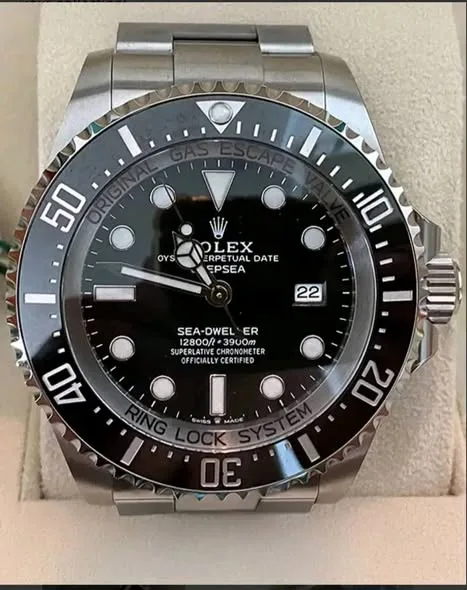
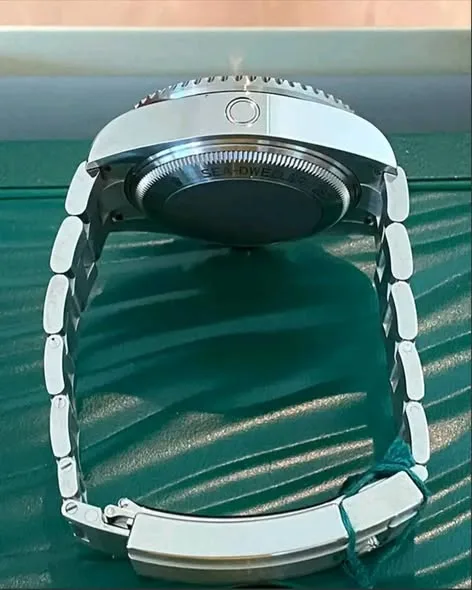
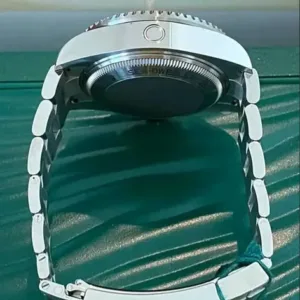
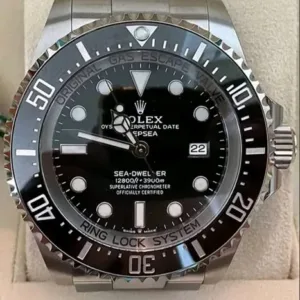
The fundamental engineering challenge of the Deepsea is not creating a seal that holds against pressure — it is creating a case structure that physically resists the deformation that crushing ocean pressure would otherwise inflict on a conventional watch case. Rolex’s solution is the patented Ring Lock System, a three-element internal architecture that transfers the load of external pressure away from the case walls and into a structural ring engineered to absorb it. At its core is a nitrogen-alloyed steel compression ring fitted inside the case — a high-performance structural element that takes the brunt of the hydrostatic load at depth, preventing the case from collapsing inward. This ring is itself supported by the Oystersteel case and reinforced by the grade 5 titanium alloy caseback — a solid, screw-down element in the same titanium alloy used in aerospace and medical implants, chosen for its exceptional strength-to-weight ratio and its specific corrosion resistance in seawater environments. The crystal above the dial is a domed, flat-edged scratch-resistant sapphire measuring 5.5mm in thickness — nearly six times the thickness of a standard Rolex sapphire crystal — its dome shape designed to distribute the pressure of 3,900 meters of seawater as a compression force across the crystal’s geometry rather than as a bending force on its center. The entire system is visible in the watch’s rehaut ring: the silver inner ring surrounding the dial is itself part of the Ring Lock System, and the phrases “Original Gas Escape Valve” and “Ring Lock System” engraved upon it are not decorative — they identify the two most important safety systems in the watch.
44mm Oystersteel Case — Redesigned for the Wrist
The 44mm case is crafted from Rolex’s proprietary 904L stainless steel — a high-corrosion-resistant alloy that takes a deeper, more mirror-like polish than the 316L steel used by most other manufacturers and resists surface degradation across decades of saltwater exposure and daily wear. At 17.5mm in thickness and 51.5mm lug to lug, the 126660 is the most physically imposing case in the standard Rolex catalog — and the engineering changes Rolex made in updating the reference from 116660 to 126660 were specifically aimed at making that size more livable. The lugs were reshaped and the bracelet widened, creating a more proportional transition from case to bracelet and distributing the watch’s weight more evenly across the wrist. The result is a watch that, despite its dimensions, wears with considerably greater comfort and balance than its predecessor — earning from collectors the nickname “the Balanced Beast” and making the 126660 the first Deepsea that serious daily wearers broadly adopted without reservation. The screw-down Triplock triple-waterproofness crown is fitted with the same three-gasket system used on the Submariner, and the automatic Helium Escape Valve — visible at 9 o’clock on the case band — allows the helium that permeates a diver’s suit during saturation dives to escape during ascent without disturbing the case seal.
The Black Cerachrom Unidirectional Bezel
The unidirectional rotating bezel is fitted with a black Cerachrom ceramic insert, graduated across 60 minutes for precise dive timing. Cerachrom is Rolex’s proprietary high-tech ceramic compound — virtually scratchproof, completely corrosion-resistant, and entirely unaffected by UV exposure or saltwater — the same material used on every modern Submariner and GMT-Master bezel, here deployed on a watch that operates in environments those models were never designed to approach. The unidirectional rotation — clicking in only one direction — is the fundamental safety feature of any professional dive timing bezel: a counterclockwise accidental knock can only underestimate remaining bottom time, never overestimate it. At depth, such an underestimate could be fatal. The Cerachrom ceramic delivers this critical safety function in a material that will read as vividly and precisely at 3,000 meters as it does at the surface.
The Black Chromalight Dial — Built for Total Darkness
The deep black dial is both clean and purposeful, designed primarily for legibility in the absolute darkness of the deep ocean — an environment where no natural light penetrates and the only illumination is the watch’s own luminescence. Chromalight luminescent markers and hands emit a long-lasting blue glow for readability that is significantly brighter and more sustained than the Super-LumiNova found in competing watches. The hour markers are extra-large compared to the Submariner — applied batons of considerable size that maximize the luminescent surface area visible underwater — and the lume fills are substantial, designed to maintain their glow across the extended bottom times that saturation divers require. The date is displayed at 3 o’clock beneath the Cyclops magnifying lens, and the dial is signed “Sea-Dweller / Deepsea / 12800ft=3900m / Superlative Chronometer / Officially Certified” — a four-liner designation that communicates both the watch’s depth rating and its movement certification simultaneously.
The Oyster Bracelet with Glidelock and Fliplock Extension
The widened Oyster bracelet — one of the key changes of the 126660 generation — features 22mm lug width and the Glidelock extension system: a micro-adjustment mechanism integrated into the Fliplock clasp that allows the bracelet to be lengthened by up to approximately 26mm in 2mm increments without any tools. This allows the wearer to adjust the bracelet fit instantly over a wetsuit during a dive and return it to wrist size at the surface without removing the watch or sourcing any equipment. The Fliplock safety clasp provides an additional layer of security against accidental bracelet opening at depth. Together, the Glidelock and Fliplock systems make the 126660 one of the most practically engineered bracelets in the Rolex catalog for actual professional use.
Powered by Caliber 3235 — Precision Certified for the Abyss
The Caliber 3235 automatic movement incorporates 14 patents, delivering high precision, a long power reserve of approximately 70 hours, and significant resistance to shocks and magnetic interference. The movement features the patented Chronergy escapement — machined from nickel-phosphorus for approximately 15% greater energy efficiency and outstanding magnetic field resistance — combined with a blue Parachrom hairspring made from a proprietary zirconium-niobium alloy that is virtually unaffected by temperature fluctuations, shocks, or magnetic interference. Paraflex shock absorbers provide additional structural resilience. Running at 28,800 vibrations per hour with 31 jewels, the movement carries Rolex’s Superlative Chronometer certification for accuracy of -2/+2 seconds per day after casing — twice as strict as standard COSC requirements. That this movement is certified to the same accuracy standard inside a watch rated to 3,900 meters as it is inside a dress watch rated to 100 meters is itself a statement of Rolex’s engineering ambition.
Condition & What’s Included
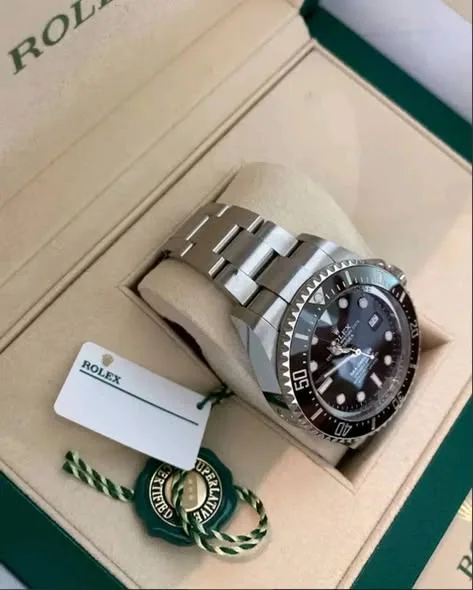
This 2021 example is in very good condition and comes as a full set with original Rolex box and papers. Authenticity is fully guaranteed on every watch sold through The Crown Collection Watch.
Shipping & Payment
This watch ships at $11,500 fully insured worldwide. Leave a message for further details or additional photos.
Why This Reference Stands Out
The 126660 is a now-discontinued reference — succeeded in Spring 2022 by the 136660, which features a larger date window, slimmer bezel, and an updated titanium caseback — making every full-set 126660 a finite and non-reproducible acquisition. Secondary market data from 2026 confirms the 126660 trading between $10,620 and $12,980 for pre-owned examples in very good condition, placing this $11,500 full-set listing squarely within the market range for a well-preserved example. For the buyer who wants the most technically capable and engineering-forward watch in the Rolex catalog — a watch that embodies the absolute outer limits of what Rolex’s case technology, movement engineering, and material science can achieve in a single instrument — the 126660 Deepsea is the definitive answer. It is the only Rolex built to dive to the ocean floor and come back ticking to -2/+2 seconds per day. That it also happens to look extraordinary on the wrist is a bonus that no engineering specification can fully capture.


 Rolex Sea-Dweller Deepsea 44mm...


Reviews
There are no reviews yet.