Born at 35,000 Feet — Seventy Years of the World’s Greatest Travel Watch
The story of the Rolex GMT-Master begins not in a watchmaker’s workshop but in the boardrooms of Pan American World Airways in the early 1950s. When Pan Am was preparing to launch the world’s first transatlantic jet passenger service, it faced a precise and immediate problem: its pilots needed to read two time zones simultaneously — home time and destination time — with a single, instant glance at the wrist. Juan Trippe, Pan Am’s visionary founder, turned to Rolex. The answer Rolex delivered was elegant in its simplicity: a fourth hand running on a 24-hour cycle, paired with a bidirectional bezel graduated to 24 hours in two colors — red for daytime hours, blue for nighttime — so a pilot could tell, at a glance, whether it was 2am or 2pm in any second time zone on earth. Those colors, naturally, were the Pan Am colors. And so in 1954, the GMT-Master 6542 was born — the first dual-timezone wristwatch designed for professional aviation, and the beginning of one of the most celebrated lineages in watchmaking history.
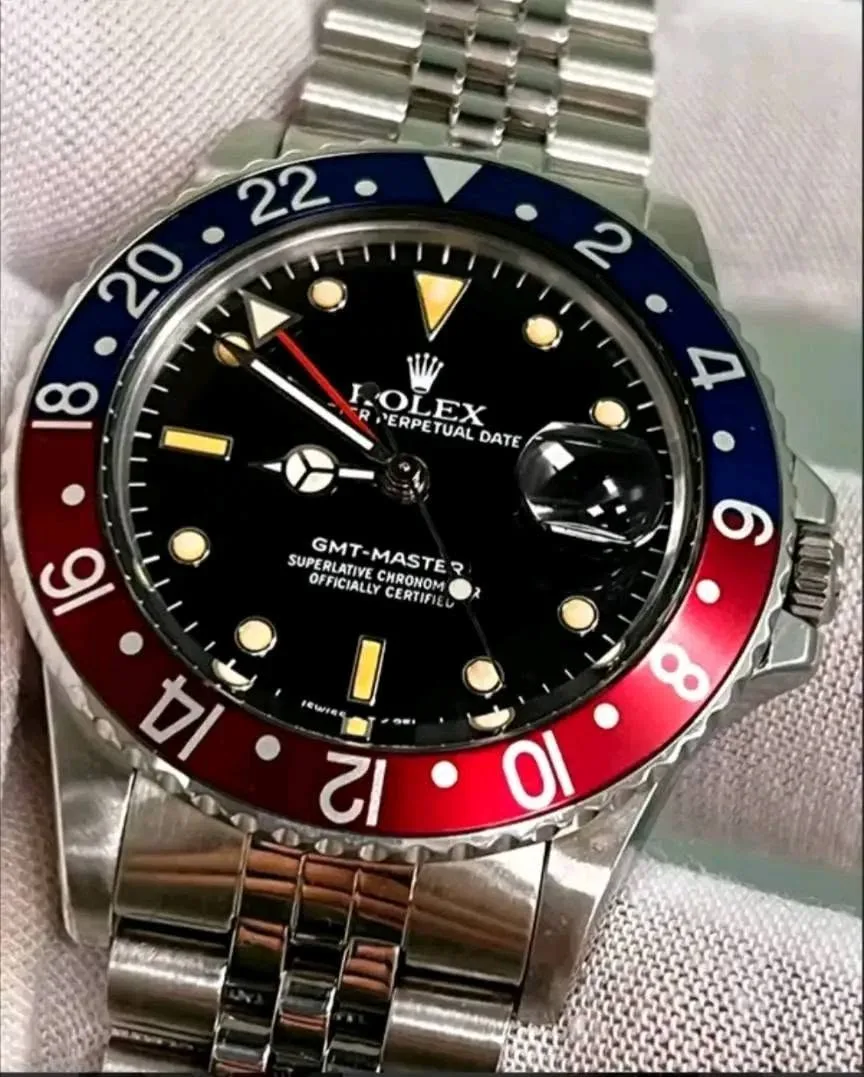
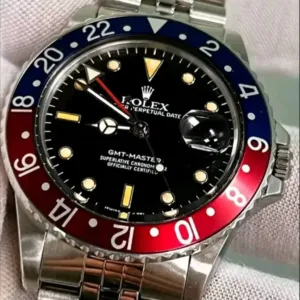
Reference 16750, produced from 1981 through 1988, represents the most evolved and practically refined chapter of the original GMT-Master story. It carried forward everything collectors love about its legendary predecessor, the 1675, while adding the one feature that transforms the GMT-Master from a vintage piece into a genuine daily companion: the quickset date function and hacking seconds. It is widely considered the sweet spot of the GMT-Master I family tree — technically modern enough for comfortable daily use, yet carrying every period detail that makes the original generation so irreplaceable. This full-set example on the Jubilee bracelet is as complete and desirable as the reference gets.
Why the 16750 Matters More Than Ever in 2026
The secondary market timing for this listing could not be more significant. In April 2026, Rolex officially discontinued the GMT-Master II “Pepsi” (ref. 126710BLRO) — the first time since 1954 that a Pepsi-bezeled GMT-Master has been absent from Rolex’s active production catalog. Purchase requests for the Pepsi configuration surged by 500% on Chrono24 in the weeks before the announcement, and secondary market prices on the ceramic 126710BLRO have since pushed to $22,000–$25,000 or higher for standard examples. With the modern Pepsi now unavailable new from any authorized dealer worldwide, collector attention has powerfully refocused on the entire Pepsi GMT lineage — and the 16750, as the most wearable and functionally complete of the vintage aluminum-bezel Pepsi references, sits squarely in the path of that renewed demand. This is precisely the kind of market moment in which full-set examples of the right reference appreciate meaningfully and quickly.
904L Oystersteel Case — The Classic Five-Digit GMT Profile
The 40mm Oyster case is built from Rolex’s proprietary 904L stainless steel — a high-corrosion-resistant alloy that delivers a deeper, more lustrous polish than the 316L steel used by most competing watch manufacturers and resists surface degradation better across decades of daily wear. The case profile is the pure five-digit GMT-Master architecture: integral crown guards flanking the signed screw-down Triplock crown, a screw-down solid caseback, and water resistance rated to 100 meters — double the 50-meter rating of the earlier 1675 reference it succeeded. That doubling of water resistance alone made the 16750 dramatically more capable as an everyday instrument. The case proportions are the distilled essence of the GMT-Master silhouette as Rolex originally conceived it — 40mm, no wider, no thicker than necessary — sitting closer to the wrist, clearing a shirt cuff more cleanly, and wearing with a leanness and refinement that no modern GMT-Master can fully replicate.
The five-digit lug profile is narrower and more elegantly swept than the broader, heavier lugs of the six-digit references that followed from 2007 onward. For collectors who wear their watches daily rather than keeping them stored away, this difference in wrist presence is felt immediately and cited consistently as one of the primary reasons experienced collectors prefer the five-digit GMT for actual use. There is a maturity to how the 16750 sits on the wrist — purposeful without being aggressive, substantial without being heavy — that the current generation of Submariners and GMT-Masters has moved away from in the pursuit of visual impact.
The “Pepsi” Bezel — The Original, The Icon, Now Irreplaceable
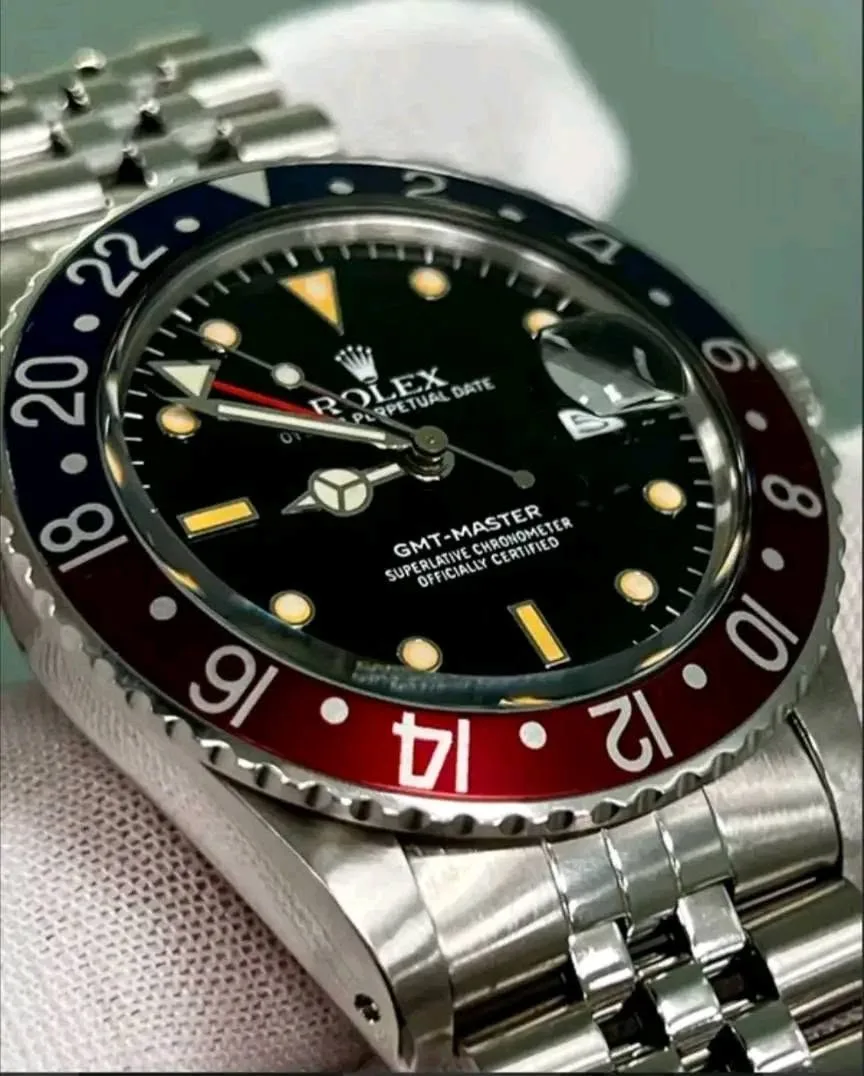
The bidirectional rotating 24-hour bezel is fitted with the iconic red-and-blue aluminum insert that earned the GMT-Master its most famous collector nickname — “Pepsi” — for its resemblance to the soft drink brand’s colors. The red half covers the daylight hours of the 24-hour scale while the blue half covers the nighttime hours, allowing the wearer to read a second time zone at an instant glance anywhere on earth and immediately determine whether it is day or night at their reference location. The concept was so intuitive and so genuinely functional that it has remained unchanged in principle across every generation of the GMT-Master for over seven decades — from the original 6542’s Bakelite insert through successive aluminum generations and into the modern Cerachrom era.
What makes the aluminum Pepsi bezel of the 16750 particularly significant in the current market environment is the very thing that differentiates it from the ceramic Cerachrom inserts of the modern era: it develops patina. Aluminum is susceptible to subtle color shifts, surface aging, and microabrasion over decades of exposure to light, UV, and contact — and each individual bezel ages differently depending on how it has lived. The character that develops on a well-worn 16750 Pepsi bezel is entirely individual to that specific watch, impossible to replicate on a ceramic bezel that by design will look identical in fifty years as it does today. For collectors who prize the living, evolving nature of a vintage piece, the aluminum Pepsi bezel of the 16750 is the definitive and irreplaceable configuration.
The Gloss Black Tritium Dial with Applied White Gold Indices
The gloss black dial on this later-production 16750 example carries applied white gold tritium-filled hour markers — the dial upgrade introduced approximately in 1986 that replaced the earlier matte dials with painted tritium indices. The applied white gold bezels surrounding each luminous plot give the dial a depth and three-dimensionality that the earlier matte configuration cannot match, and the tritium lume has developed the warm, creamy ivory patina characteristic of this production era — consistent, natural, and deeply attractive against the black dial surface. This aging is the direct result of decades of natural development and is impossible to replicate artificially, making each original tritium dial as singular and irreplaceable as a fingerprint. The matching tritium handset — including the 24-hour GMT hand in its distinctive contrasting color — carries the same warm aging, and on a well-preserved example the harmony between dial plots and handset under both visible light and UV inspection is one of the most compelling details in all of vintage Rolex collecting.
The dial carries the clean two-liner text configuration: “Rolex / Perpetual Date” above center and “GMT-Master / Superlative Chronometer / Officially Certified” below — without additional certification lines of later references — maintaining the visual balance and period authenticity that collectors most consistently prize on this generation of the model.
The GMT Complication — Three Time Zones in a Single Glance
The additional 24-hour GMT hand completes one full revolution every 24 hours and is read against the bidirectional rotating bezel, allowing the wearer to set a second time zone by aligning the bezel’s reference point with the GMT hand. The result is a watch capable of displaying three time zones simultaneously: local time on the regular hour hand, a second time zone on the GMT hand and bezel, and the date at 3 o’clock beneath the standard magnifier. For frequent travelers, pilots, global business professionals, or anyone who communicates daily across time zones, the GMT function is one of the most genuinely practical complications in all of watchmaking — elegantly executed and intuitively readable without a moment’s thought after the initial setup. This is a functionality that has been relied upon by Pan Am pilots, Apollo astronauts, and world travelers for over 70 years, and one that has lost none of its utility in a world of increasingly compressed international business.
The Jubilee Bracelet — Dressier, More Comfortable, and Factory Original
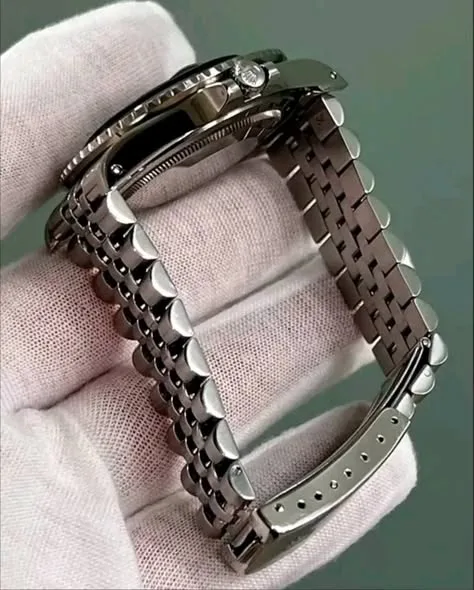
This example is fitted to Rolex’s five-link Jubilee bracelet — available on the GMT-Master alongside the Oyster throughout this era and considered by the majority of collectors and experienced daily wearers to be the more elegant, more comfortable, and more historically appropriate of the two options. The fluid, articulated five-link construction drapes across the wrist with a softness and natural movement that the three-link Oyster bracelet doesn’t match, making the Jubilee particularly well suited to extended daily wear across long international flights or working days. Later production 16750 examples fitted with the Jubilee from the factory carry a “Fifty” stamp code on the first link after the endlinks — confirming factory-original pairing and adding meaningful provenance to a full-set example. On a watch of this age, an unpolished, well-preserved Jubilee with solid links and minimal stretch is increasingly rare to find, and adds a meaningful premium to any 16750 transaction. Notably, when Rolex reintroduced the Pepsi bezel to the GMT-Master II in 2018 with the 126710BLRO, it chose to launch it exclusively on the Jubilee bracelet — a deliberate nod to the original 1954 GMT-Master’s Jubilee heritage, and a confirmation of how deeply associated the Jubilee remains with the Pepsi GMT identity.
Powered by Caliber 3075 — The Quickset That Changed the GMT-Master
The defining technical advance of the 16750 over its predecessor is the Caliber 3075 movement — the first GMT-Master caliber to feature a quickset date function. On the earlier 1675, setting the date required cycling the hour hand around the dial repeatedly until the calendar advanced to the correct date — a slow, cumbersome process that tested the patience of daily wearers and required resetting both time and date from scratch after any transatlantic crossing. The Caliber 3075 eliminated this entirely: the date now advances independently by pulling the crown to the first position and rotating, just as on a modern watch. This single improvement makes the 16750 dramatically more practical for everyday international use than any 1675 before it — and is the primary reason collectors who actually wear their vintage watches consistently cite the 16750 over its predecessor.
The movement also introduces hacking seconds — the ability to stop the seconds hand by pulling the crown — enabling precise synchronization to the exact second when setting local or reference time zone during travel. Operating at a high-beat 28,800 vibrations per hour with approximately 48 hours of power reserve, the 3075 is a robustly built, thoroughly proven automatic movement that watchmakers regard as highly reliable and very straightforward to service. It has powered the 16750 in daily use across four decades with a reliability record that speaks for itself.
Condition & What’s Included
This example is offered as a full set with original Rolex box and papers — a genuinely significant distinction for a vintage reference of this age, where box-and-papers sets command a meaningful premium on the secondary market and grow increasingly scarce with every passing year. Full provenance documentation verifies originality, supports authenticity, and protects value at the time of eventual resale. Further condition details and images are available upon request.
Shipping & Guarantee
Every watch sold through The Crown Collection Watch ships fully insured with signature-required, worldwide delivery, backed by our full authenticity guarantee. This example is offered at $18,000 shipped worldwide — leave a message for additional photos and further details.
Why This Reference Stands Out
The 16750 is the reference that experienced GMT-Master collectors most consistently identify as the one they would choose if they could own a single GMT-Master. It delivers every visual and design element that defines the model — the Pepsi bezel, the 40mm Oyster case with crown guards, the 24-hour GMT hand, the gloss tritium dial — while adding the quickset date and hacking seconds that make it genuinely livable as a daily watch in a way the earlier 1675 simply is not. A full-set gloss-dial example on the Jubilee is the most complete and most desirable configuration the reference offers, and in the context of a 2026 market where the modern ceramic Pepsi has just been discontinued for the first time in 71 years, the timing for acquiring a full-set vintage aluminum Pepsi GMT has never been more compelling. Secondary market data confirms the 16750 has outperformed the broader Rolex index over the past year, up 8.8% versus the index’s 6.7%, with full-set and unpolished examples consistently commanding the highest individual premiums. At $18,000 for a full-set Jubilee example, this listing represents outstanding value in a reference that the global secondary market is actively and urgently rediscovering.





 Rolex GMT-Master 40mm “P...


Reviews
There are no reviews yet.